
Industrial Automation Training (PLC HMI SCADA VFD)
9
Modules
Online, Offline & Hybrid
Type
Beginner friendly
Skill Level
60h - 120h
Duration
English
Language
Overview
We provide the best industrial automation training course on PLC HMI SCADA VFD, it is a discipline that includes knowledge and expertise from various branches of engineering including electrical, electronics, instrumentation , mechanical and more recently computer and software engineering as well with the introduction of IIoT.
Key facts of this course:
- Knowledge enrichment through learning TÜV SÜD certified PLC SCADA Automation course.
- 100% Placement support upon completion of this course.
- Improvement in employable PLC SCADA Automation skills widely acceptable by industry, nationally and internationally.
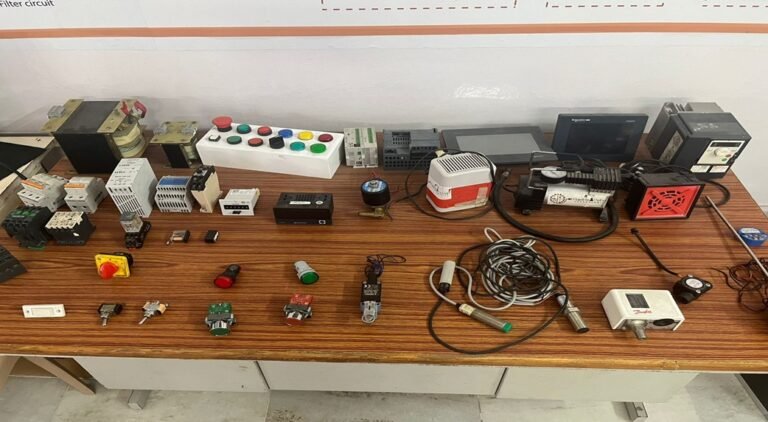
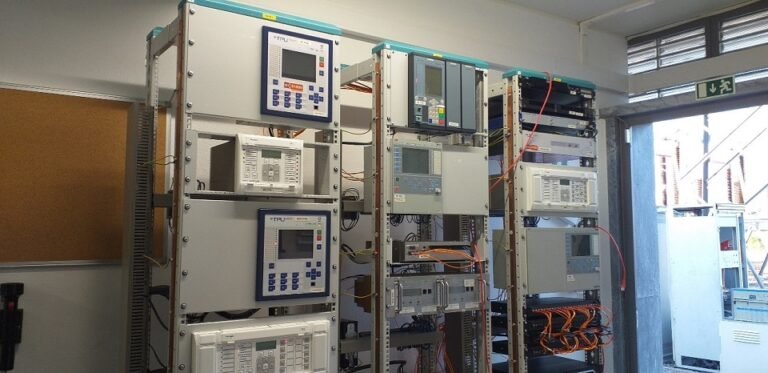
- Industrial automation Hands-on training on latest products & softwares.
Who is the course for?
Any student or Working professional who is willing to join the Industrial Automation Training including:
Electrical and Electronics Engineering (EEE), Electronics and Instrumentation Engineering (EIE), Electronics and Communication Engineering (ECE) & Mechanical Engineering students, Masters, Diploma, ITI, BSC Electronics Students and Working professionals can join this course.

Learning Path
- What Is Electricity – Charge, Current, Voltage, Resistance & Ohm’s Law
- Conductors And Insulators
- Series And Parallel Connection Of Loads
- Generation Of Ac And Dc With Electromagnetic Induction In Generators And Wave Forms
- Transformers – Types, Working And Calculations
- Different Types Of Power And Calculations Of Power And Amperes Indifferent Generators
- Energy Consumption Billing By Electricity Board
- Types Of Loads
- Generation, Transmission, Distribution & Utilization Of Power
- Measurements Of Current, Voltage & Power Using Ammeter, Voltmeter, Multi Meter, Clamp Meter, Energy Meter
- Star-delta Connections
- Difference Between 1-phase And 3-phase Systems
- 1-phase And 3 Phase Ac Induction Motor
- Power Circuit And Control Circuit
- What Is Automation
- Basic Elements Of An Automation Systems
- Levels Of Automation
- Why Choose Automation As A Career
- History Of Automation
- Types Of Control Systems
- Control Hardware, Software, Digital And Analog Inputs And Outputs
- Control System Architecture & Automation Hierarchy.
- Automation Products (PLC, SCADA, HMI, VFD)
- Automation Brands
- Introduction To Communication Protocol
- Switchgear: Various Switches(SPST, SPDT, Selector Switch), Push Buttons(NO, NC)
- Relays, Contactors, Timers & Counters.
- Protection Devices : RCCB, MCB, FUSES, ELCB, Overload Relay, Sockets
- Solenoid Valves, Control Valves, Level Sensors, Flow Sensors, RTD, Proximity Switch, IR Sensor, Motion, Metal & Non Metal, Float Sensor, Pressure Sensors , Encoder, Capacitive Sensor, Limit Switch, Potentiometer, Buzzer, Pump.
- Single Phase And 3 Phase Circuits
- Control And Power Circuits For Motors
- Connection Of Loads (Series And Parallel)
- Inching /Jogging And Latching Applications
- Relay Logic Wiring Techniques Using Timers
- DOL Starter With Power Contactor And Control Contactor
- Forward And Reverse Operation Of An Induction Motor With Interlocking
- Star- Delta Starter (Manual And Automatic)
- Automatic Tank Level Control Circuit
- Sequential Starting Of Motors
- What is a PLC , History of PLC
- PLC Architecture
- PLC Hardware & Software
- PLC I/O’s: DI, DO, AI, AO.
- Power supply, CPU, Memory module, IO module , communication protocol
- Sourcing & Sinking concepts.
- PLC models & Types of CPU.
- Digital & Analog addressing: Bit, Byte & word addressing concepts
- Scan cycle.
- PLC programming languages overview.
- PLC Programming Instruction – NO, NC , Timers , Counters , Comparator, Math, Move, Jumps & Sub-Routines
- Program Upload / Download
- Monitoring of program.
- PLC Programming instructions.
- Bit Logic , Timers , Counters , Comparators , Math , Move , Jump & Sub-Routine
- PLC Programming applications
- PLC Selection
- PLC configuration.
- PLC Panel wiring.
- PLC commissioning.
- Powering up a PLC
- Trouble shooting and Fault analysis.
- Networking and Communication with SCADA & HMI.
- Introduction to HMI
- Hardware and software
- HMI features
- Tag management, Alarms, Trends, Security, Recipe.
- HMI programming applications
- Communication with PLC
- HMI screen development
- Screen navigation
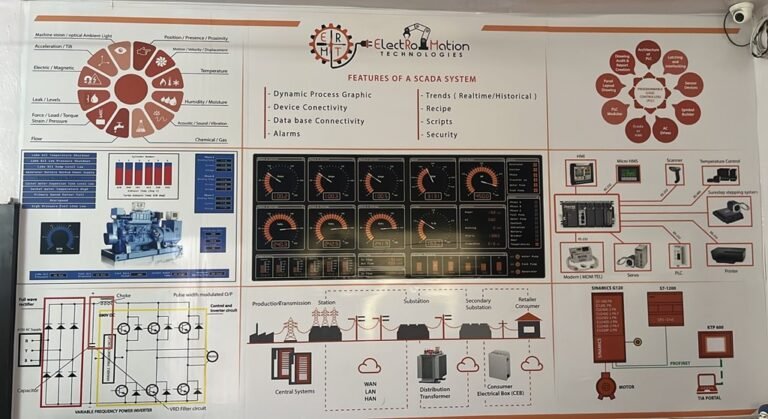
- Introduction to SCADA
- Tag management :-Creating tags and addressing( internal & External )
- Application of SCADA
- Screen development
- Images and objects configuration
- Dynamic representation-Movement and filling
- Alarms
- Trends
- Security
- Recipe
- Windows navigation
- Recipe management
- Communication with PLC.
- Introduction To VFD’S
- Working Principle.
- VFD Architecture.
- VFD –Hardware & Software.
- Types Of VFD’s :-Single Phase And 3 Phase Drives
- Drive Selection
- Commissioning Of VFD
- Parameterization ( Programming Of VFD )
- VFD Operation: – Local, Remote(2 & 3 Wire)
- Speed Modulation (Fixed / Preset Speeds)
- Advantages And Applications Of VFD’s